UX, AI, and the Solo Builder Workflow: Chris on Vision Over Execution
Welcome to our UX Professional Spotlight series, where we explore the journeys and insights of professionals in User Experience Design. Today, we're featuring Chris, a product manager at a B2B image-search company who also ships his own products as a solo builder.
At a glance
- Role: Product manager at a B2B image-search company, plus solo builder on the side
- Focus: Shipping his own products end to end, from vision to launch
- Signature workflow: Feeding interview notes to an LLM to generate a scannable insights dashboard in under ten minutes
- Pays for: Miro, ChatGPT, Claude, and the Gemini API
Building Has Become Cheap
Chris splits his time between a day job and a steady stream of side projects, the kind of work that used to stall for lack of hours. Vibe coding changed that.
"With vibe coding, I've really been enabled to build the kind of projects that in the past I used to code myself, but that just used to take really long," he says. "When you work full time as a single person, you often don't have the time to get something to the quality you're imagining."
The shift, as he sees it, is that the hard part has moved. "Now we're moving into a new age where building has become cheaper, where it really becomes more about what you want to build and what will be useful. Because the building itself is cheap, anything you can imagine, you can pretty much build it." Even the workarounds are fading. "A lot of the old vibe coding hacks, this whole prompt engineering field, is already disappearing very fast, because the new models do all of that for you."
If execution is cheap, the scarce thing is clarity. "All of this points in one direction: how do we create more clarity in the product? And that comes from talking to users and getting more understanding, this whole field of UX research."
The Wealthy Family Analogy
Ask Chris what actually changed in how he works, and he reaches for an analogy about leverage.
"Now, with vibe coding, I feel like I come from a wealthy family. Instead of having to execute everything myself, I can let 'others,' the agents, execute lots of the heavy lifting. In the past, if you had a crazy amount of money, you could already do this. You hire the best people in the world, you have your own vision, and you tell them you want it like this. You're very involved in the building, but you don't execute the small details."
The point is not laziness, it is altitude. "You have your grand vision, and the more informed you are, the better that vision will be. So there's still real skill involved, but you no longer have to take care of those small details." That freedom comes with a new bar. "It's no longer enough to be a good executor. Now you really have to be a good strategic thinker, a good visionary, someone who knows what actually needs to be built."
Afraid and Embracing It
Chris is not evangelical about AI so much as clear-eyed. "I'm also afraid of AI, but I'm embracing it. It's a duality. On the big-picture level I'm scared of where it's going, but in my day to day I'm just amazed at how empowering it is."
What excites him is the collapse of the old waiting game. "It feels like suddenly you don't have to come from a privileged family or work your way up for fifteen years until someone gives you the chance to develop your visionary thinking. You can start doing that straight away."
He is careful not to oversell where the leverage lands. It is strongest in his early-stage solo work, but it is not exclusive to it. "Even in a more mature organization there's definitely a way to set AI up to be very involved in what you do. The value it generates is just a different one, but the value is always there."
From Interviews to Insight
Chris got into UX research the practical way: he wanted to know if the thing he built was any good. "For one of the products I'd built, I wanted feedback and to understand where to take it, so I don't get stuck in my own ivory tower. So I conducted interviews."
He is opinionated about capture. "I personally believe in manually writing down the highlights of what someone says rather than transcribing everything, just to reduce the noise and stay focused." But the notes are never the point. "The interview itself is just an intermediary step. What I actually care about is, so what, what do I do now?"
That is where the LLM comes in. He feeds it the insights and asks where people converge and where they split. "You could get a dashboard where, say, out of ten people eight had a specific problem, phrased differently but the same theme. And where do they disagree, which is also helpful, because then maybe there's an ideal customer profile I should refine." Being a visual thinker shapes the output. "I don't like reading long documents, so I always get the output as a beautifully designed webpage I can scan quickly."
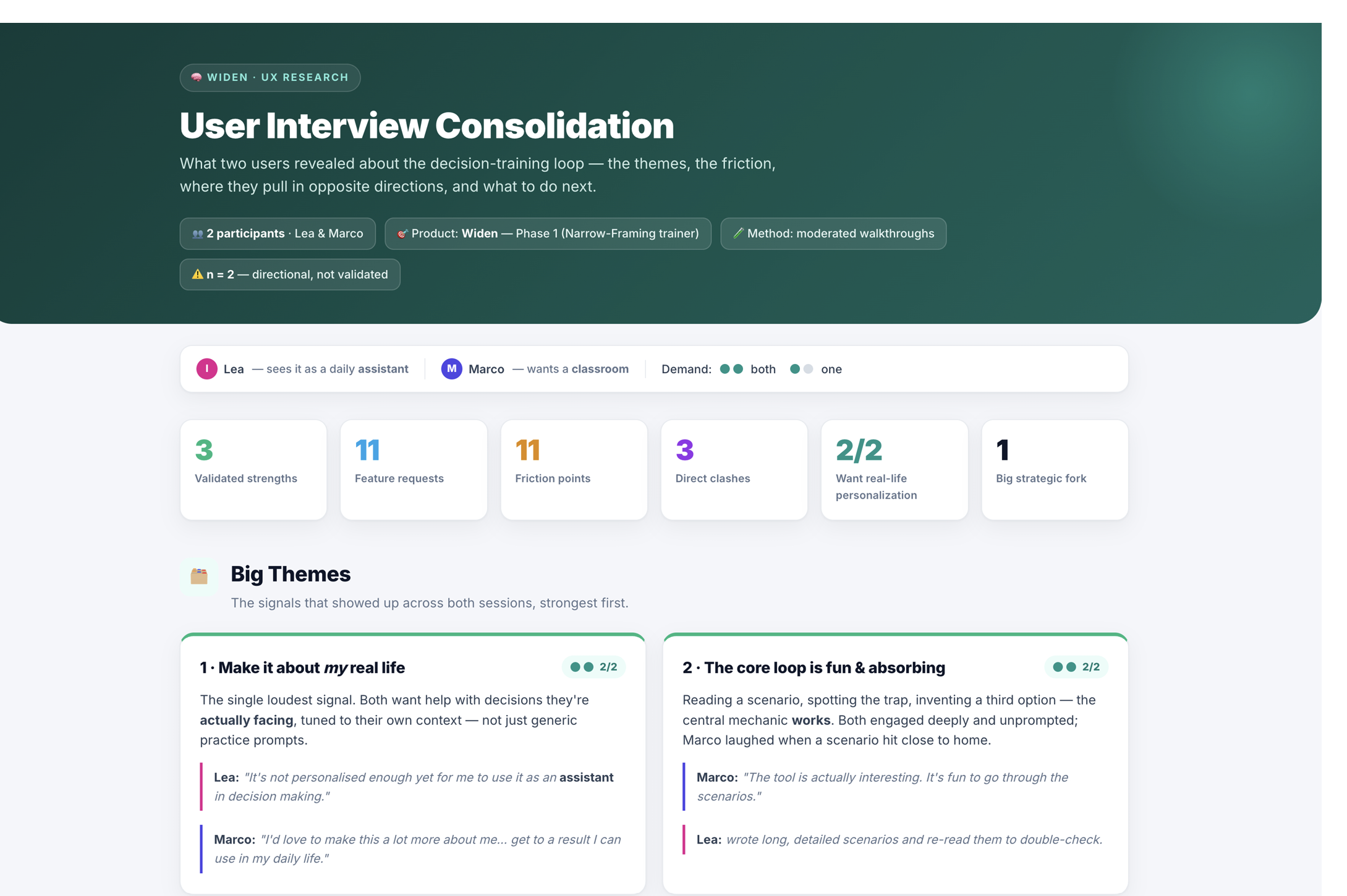
One of Chris's actual insight dashboards: interview notes turned into a scannable, designed web page.
The Ten-Minute Dashboard
His research loop lives in co-work mode with Claude. "I have a folder with all the interview notes I took, and it can expand over time, and it automatically understands what to look at. Then it outputs the dashboard, and from there I have my actionables directly."
Crucially, he wires in context so the analysis stays honest. "I always also tell it to look at my product, my roadmap, and my vision document, so it knows what assumptions I'm making and where I might already be going off the rails." Then come the same handful of questions every time: the big themes, where people agree, what they like and dislike, where they disagree, and the most likely next action.
The whole dashboard takes "not even ten minutes." The real work happens up front: a vision document and a rules file capturing his thinking about the product. Once those exist, building the dashboard is "really just putting the transcripts in the folder" and asking for an updated, visualized HTML page.
The Tools He Actually Keeps
Dedicated UX research tools have not stuck for Chris. "I've played around with some tools where you capture your insights, but I often find they're very process oriented. They love reveling in theories of how UX research should work, and they're not very focused on what you're actually trying to do, which is make better product decisions and build things people like."
His real favorite is Miro, used less as a research tool and more as a second brain. And Figma? "Of course, but it's really decreased now with AI. Why would I build a prototype in Figma when I can vibe code it way faster, in the exact design specifications I wanted?" He sees the professional workflow shifting to design systems that feed code directly. "It's much better to have a designer create the design system, give it to Claude, and say vibe code it based on this design system."
He points to a designer he works with as the template for where this goes. "She builds components in Figma but then exports code components and pushes them to Storybook, which the developers use in production-ready code. So she's become an end-to-end designer. The Figma file is always just an artifact, it's going to be thrown away and no one cares."
Where the Roles Are Heading
The through-line of Chris's thinking is that intermediary steps are disappearing, and roles are converging on ownership.
"All the roles, whether UX researcher, designer, developer, or product manager, will move toward much more end-to-end ownership, with much less separation of concerns. Those intermediary steps will very strongly disappear."
That does not erase specialization. "Your individual strengths still matter. As a UX researcher you'll still have unique value over an engineer or a product manager, so the question is how you strengthen that and lean into it rather than give up on it."
His closing advice is about identity as much as tooling. "Working with AI is a constant reinvention. The best way to work is almost to become a human-AI hybrid. Don't have too much pride that says you should do everything yourself. Fully integrate with the AI to empower yourself, and learn from it in the process."
Chris
---
Find Chris online:
---
We hope you found Chris's interview insightful. His perspective on building with AI offers practical insight for UX professionals at every level. Want more conversations like this? Join our newsletter for new interviews and the latest UX tools in your inbox.